
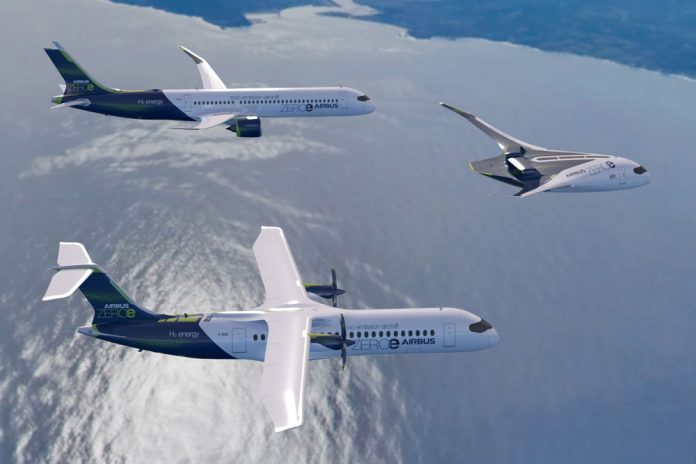

Airbus has presented three concepts of future aircraft that will not emit carbon dioxide during flight.
The company intends to achieve this by switching to hydrogen as the main fuel.
The first two planes are similar to existing airliners. One of them will be powered by jet engines and will be able to carry 120-200 passengers over a distance of 3,700 km. Hydrogen in liquid form is supposed to be transported in the tail behind the partition, which ensures the sealing of the cabin.
The prototype of the second airliner will be existing regional turboprop planes. Airbus assumes that an aircraft of this type will be able to fly up to 1,800 km and carry up to 100 passengers.
The third "flying wing" concept is new to civil aviation and is not currently used anywhere for commercial transportation.
It is assumed that the entire fuselage will act as a wing, inside which there will be a cabin for 200 passengers and fuel tanks. Airbus emphasizes that this concept makes it possible to work out different layouts of the cabin and the location of fuel tanks.
The presented concepts are a starting point for further research on the creation of an aircraft that does not emit carbon dioxide. That is why the final version of the airliners, if the project becomes a reality, may differ significantly from the concepts.
Airbus expects that hydrogen airplanes will enter commercial operation in 2035, but admits that their use will require significant changes to airport infrastructure.



Comments